
If you’re planning a semester, an internship, or a full academic year abroad, you’ve probably heard this:
“I already have the EHIC, I’m covered.”
It sounds logical, but it´s not the smartest move
Of course, the European Health Insurance Card (EHIC) is extremely useful. You should absolutely carry it.
But it’s not the same thing as travel insurance.
When you live abroad, you will likely want more than public healthcare access. Let’s break down what the EHIC vs Travel Insurance do and why you need both.
What EHIC vs Travel Insurance Actually Do
Before we go into the details, here’s a clear side-by-side comparison of what the EHIC actually covers and what travel insurance adds on top.
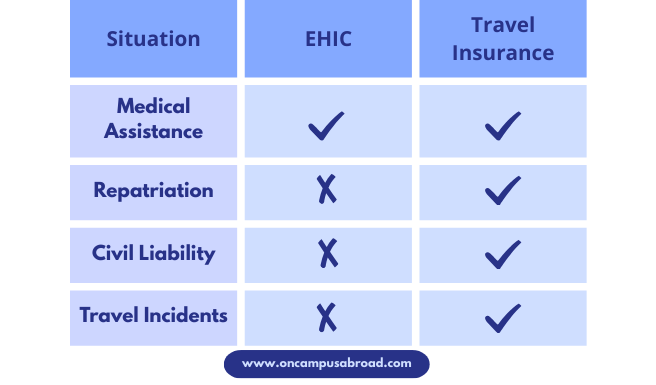
The EHIC card lets you get medically needed public healthcare. You get it on the same terms as local residents in EU/EEA countries and Switzerland.
That means that you:
- can visit public medical facilities.
- can receive emergency treatment.
- pay the same fees as locals.
- are treated within the public healthcare system.
So far, so good.
But here’s the detail:
The EHIC doesn’t make healthcare free. It makes you subject to local rules, and those rules vary a lot from country to country. For example, in some countries:
- You must pay upfront and request reimbursement later.
- Emergency rooms charge fixed fees.
- Ambulances are billed.
- Hospital stays require daily contributions.
The EHIC card only covers medically necessary state healthcare during a temporary stay.
It does NOT cover:
- Private clinics (often the fastest option)
- Full reimbursement of treatment costs
- Medical transport back home
- Travel mishaps
- Liability incidents
And when you’re living abroad, those gaps are usually what turn a simple situation into a complicated one.
If you get sick while studying abroad, the hard part usually isn’t the medical visit itself. It’s everything around it.
Where do you go?
Who do you call?
Do you need to pay upfront?
How do you explain your symptoms in another language?
Travel insurance means you’re not figuring that out alone.
Instead of searching for hospitals in a language you don’t speak, you call one number, and someone guides you step by step.
Instead of paying thousands of euros out of pocket, the insurer can handle payment directly with the hospital.
It’s not just about coverage, it’s about having support when you’re far from home.
Up to this point, we’ve only talked about healthcare access. But studying abroad involves much more than visiting a doctor.
The real differences appear in situations that fall completely outside public healthcare coverage. These are areas where the EHIC offers no protection at all, but travel insurance does.
Repatriation
Here’s the biggest gap.
If you can’t continue your stay because of a serious accident or illness, you may need medically supervised transport back to your home country.
The EHIC never covers medical repatriation.
Depending on distance and medical needs, costs can range from €5,000 to €60,000 or more.
Without insurance, that cost would fall on you or your family.
It’s not something anyone plans for, but it’s exactly the kind of situation that makes insurance essential.
Liability
Studying abroad means renting a flat, cycling around cities, sharing spaces, and meeting new people.
Civil liability means you could be legally responsible for compensating someone if you accidentally hurt them or damage their property.
Think about this:
You hit a car or someone while cycling
- You hit a car or someone while cycling
- You damage your roommate’s laptop
- You accidentally break something at a party.
Travel insurance usually includes personal civil liability coverage, which can cover compensation and legal defense costs.
And abroad, claims like these can easily reach thousands of euros.
Travel Mishaps
When you’re studying abroad, you’re constantly moving, weekends away, trips home, and last-minute getaways.
That can lead to:
- Lost luggage
- Cancelled flights
- Missed connections
- Lost documents
- Extra accommodation costs due to delays
These aren’t dramatic emergencies, but they are stressful when you’re living on a student’s budget.
And they aren’t medical situations either, so again, completely outside the scope of the EHIC. However, they are exactly what travel insurance is designed for.
Why You Actually Need Both
The question isn’t EHIC or travel insurance. You should carry your EHIC.
But don’t confuse access to public healthcare with full protection.
The European Health Insurance Card gives you access to a healthcare system. Travel insurance gives you assistance, coordination, financial protection, and support whenever things don’t go as planned.
And when you’re living abroad, far from home, that difference matters.
After years of supporting mobility students, we’ve seen many issues that can arise when you move abroad. That’s exactly what OnCampus Abroad insurance is built for. It covers medical assistance, liability, repatriation, and travel mishaps. So you can focus on your experience, not on what might go wrong.
Safe travels!